

AEO, GEO and SEO are no longer three separate conversations. If your business wants to get found online in 2025 and beyond, you need to understand how they work together and why ignoring any one of them could mean your competitors are getting recommended by AI while you are not.
At dijitul, we have been helping UK businesses with technical SEO for over 20 years. And right now, this space is changing faster than it ever has.
What Is SEO, and Does It Still Matter?
SEO (Search Engine Optimisation) is the process of improving your website and its content so that search engines like Google rank you as the most relevant result for a given search.
Google uses over 200 ranking factors to decide who gets the top spot. Things like unique and well-structured content, quality backlinks, page speed, and logical site architecture all play a role.
So yes, SEO absolutely still matters. But the game has shifted.
What Is AEO, and Why Is Everyone Talking About It?
AEO stands for Answer Engine Optimisation. It is the practice of structuring your content so that AI-powered tools like ChatGPT, Google’s AI Overviews, and Perplexity can find, understand, and cite your business when someone asks a relevant question.
Where traditional SEO was about ranking on a results page, AEO is about becoming the answer itself.
Instead of a user scrolling through ten blue links, they ask an AI a question and get a direct response. The AI pulls that response from the most authoritative, well-structured, and frequently referenced sources available.
If your website is not built with this in mind, you are invisible to that process.
What Is GEO, and How Is It Different?
GEO stands for Generative Engine Optimisation. It is closely related to AEO but focuses specifically on being cited within generative AI responses, the kind of answers produced by large language models like ChatGPT, Claude, or Gemini.
Think of GEO as the next evolution of link building. Rather than trying to get a backlink from another website, you are trying to get your business mentioned, recommended, or cited inside an AI-generated answer.
The practical difference between AEO and GEO is subtle, and many people use the terms interchangeably. What matters is that both require a proactive, structured approach to your content, your authority signals, and how your business is discussed across the web.
Why AEO, GEO and SEO Work Best Together
Here is the thing that often gets missed. AEO and GEO are not replacements for SEO. They are built on top of it.
AI models learn from the web. They pull from pages that rank well, that are trusted, that are cited by others, and that are structured clearly. A strong SEO foundation is still the bedrock of everything.
What has changed is that the payoff looks different. Instead of a click from a Google results page, you might now get a direct recommendation inside someone’s ChatGPT conversation. That is a completely different kind of visibility, and in many cases, a far more powerful one.
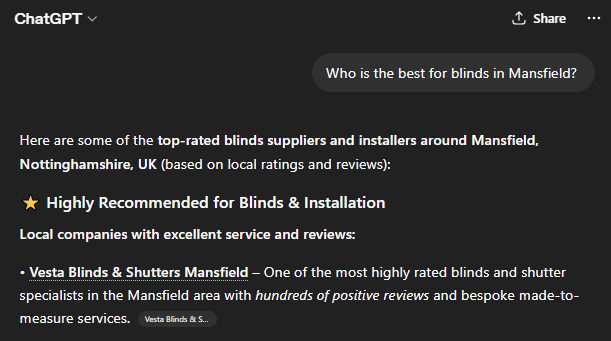
A client of ours in Mansfield, Vesta Blinds, comes up when you ask ChatGPT* for blind suppliers in the area. That is not luck. That is the result of consistent, structured SEO work with AI citation built into the strategy from day one.
7 Ways to Optimise for AEO, GEO and SEO Right Now
- Write content that directly answers questions
AI models favour content that clearly and concisely answers a specific question. Think about what your customers actually ask and write pages that answer those questions in plain language. - Use structured data and schema markup
Schema markup helps search engines and AI models understand what your content is about. FAQ schema, LocalBusiness schema, and HowTo schema are all worth implementing. - Build your authority signals
AI models do not just look at your website in isolation. They consider how widely your business is discussed and referenced across the web. Get listed in directories, earn press coverage, and build citations consistently. - Keep your Google Business Profile updated
For local businesses especially, a well-maintained Google Business Profile is one of the most important authority signals you can have. It feeds directly into local AI recommendations. - Create genuinely useful, specific content
Generic content does not get cited. Content that is detailed, accurate, locally relevant, and clearly written for a real audience does. Write for people first, but structure it so AI can understand it too. - Earn quality backlinks
Backlinks remain one of the strongest signals of authority. A page that is linked to from credible sources is far more likely to be referenced by an AI than one that sits in isolation. - Think about how AI reads your pages
Clear headings, short paragraphs, logical structure, and well-written meta data all make it easier for AI to parse and use your content. If a page is a mess to read, an AI will skip it.
Is Your Business Ready for AI Search?
The businesses that are winning AI citations right now are not doing anything radically different. They have strong SEO foundations, well-structured content, and a presence that goes beyond just their own website.
If you are not sure where you stand, or if the whole thing feels overwhelming, that is exactly what we are here for. Our team has been doing this for over two decades, and we are well-placed to help you navigate the shift from traditional search to AI-powered discovery.
Get in touch with the team at dijitul.uk and let us take a look at where you are and what needs to happen next.
Frequently Asked Questions About AEO, GEO and SEO
What is the difference between AEO and GEO?
AEO (Answer Engine Optimisation) focuses on getting your content surfaced as a direct answer by AI tools. GEO (Generative Engine Optimisation) focuses specifically on being cited within generative AI responses from models like ChatGPT or Gemini. In practice, the strategies overlap significantly, and both sit on top of a solid SEO foundation.
Does SEO still matter now that people use AI instead of Google?
Yes, absolutely. AI models learn from the web and they prioritise content that is well-ranked, authoritative, and clearly structured. A strong SEO strategy is still the foundation of everything else. AEO and GEO build on top of it rather than replacing it.
How do I know if my website is being cited by AI tools?
You can test this manually by asking tools like ChatGPT or Perplexity questions relevant to your business and location, then seeing what they recommend. A more thorough approach involves an audit of your content structure, authority signals, and schema implementation. This is something we offer as part of our SEO and AEO services at dijitul.
Leave a Reply