 Olly Mooney

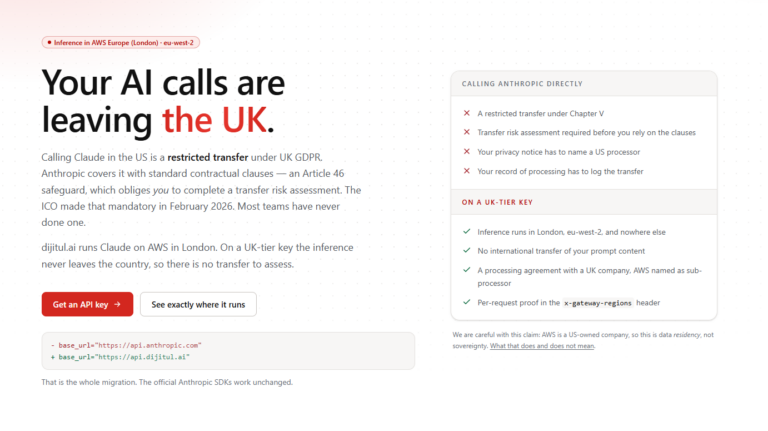
If a UK business calls the Claude API directly, Anthropic’s own documentation says inference can run in any available geography by default, and the data is stored in the US. There is a US-only setting, but no UK-only one. If a client or a contract needs UK processing, you need a different route to the same models, and the paperwork changes with it.
This post is for whoever has been asked “where is the data processed?” and needs a straight answer before any code is written: a developer, an IT lead, or the owner of a firm handling client data. We run a UK-hosted route to the Claude API ourselves, so read it with that in mind. It is not legal advice: the ICO publishes the rules, and we link to its guidance below. Every source was checked on 20 November 2026.

Fact 1: called directly, the Claude API has no UK-only setting
Anthropic’s data residency documentation describes two separate controls. Inference geo decides where the model runs. Workspace geo decides where data is stored at rest. For the Claude API today, the options are:
- Inference geo, “global”: the default. Inference may run in any available geography.
- Inference geo, “us”: inference runs only on US-based infrastructure. On current models this is priced at 1.1 times the standard rate.
- Workspace geo: “us” is the only choice available.
Anthropic’s privacy pages put it in plainer words. By default, customer traffic may be routed to select countries in the US, Europe, Asia and Australia, and data is stored in the US.
None of that is a criticism. Global routing exists for speed and availability, and Anthropic documents it openly. It simply means the honest answer to “is the Claude API processed in the UK?” is “not necessarily, and we cannot require it”.
Fact 2: on a cloud platform, “EU” can mean seven countries
The models behind the Claude API are also sold through cloud platforms. Anthropic’s documentation says that on Amazon Bedrock the region is decided by the endpoint or inference profile you call, not by the Claude API setting above. AWS describes the options in its cross-Region inference guide: a call can stay in one Region, be routed within a geography such as the EU, or be routed worldwide.
| Route to Claude | Where inference can run | UK only? |
|---|---|---|
| Claude API direct, default setting | Any available geography | No |
| Claude API direct, US-only setting | US-based infrastructure | No |
| Amazon Bedrock, global profile | Any supported AWS commercial Region | No |
| Amazon Bedrock, EU profile called from London | Frankfurt, Stockholm, Milan, Spain, Ireland, London or Paris | No |
| Amazon Bedrock, In-Region call to London | AWS Europe (London) only | Yes |
The fourth row is the one that catches people out. AWS’s own model page for Claude Sonnet 4.6 lists those seven destinations for an EU profile called from London. So “we use EU hosting” can mean one named country or seven. Both can be covered by the adequacy rules in Fact 4. Neither is a promise that data stays in the UK. Ask a supplier which they use, in writing.
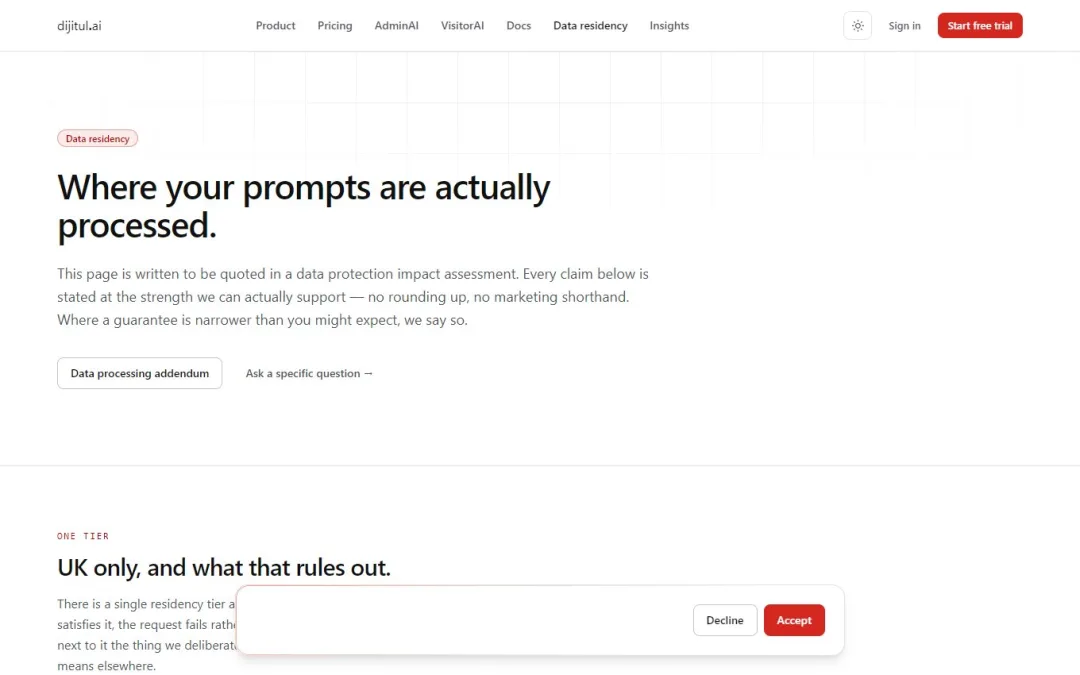
Only some models can be invoked In-Region in London, and they are not always the newest. The dijitul.ai residency page lists which ones it serves and refuses the rest.
Fact 3: where data is processed and what is kept are separate questions
Residency is about where a request runs. Retention is about what exists afterwards. A client asking about your Claude API project usually wants both.
- Claude API, direct: Anthropic’s privacy pages say API inputs and outputs are automatically deleted within 30 days, with exceptions that include usage policy enforcement and legal requirements. By default, inputs and outputs from its commercial products are not used to train its models.
- Amazon Bedrock: AWS’s data protection documentation says model providers have no access to the accounts the models are deployed in, so they do not see customer prompts or completions. Retention depends on the model. AWS documents that a few of the newest Claude models require prompts to be kept for up to 30 days for abuse detection.
- A UK gateway: the dijitul.ai security page says request and response bodies are not written to disk by default. It records metadata such as time, model, status and token counts. Debug capture is opt-in per key and expires after at most 24 hours.

Fact 4: once personal data leaves the UK, the transfer rules apply
The ICO’s brief guide to international transfers sets a three-step test. You are making a “restricted transfer” if the answer to all three is yes:
- Does the UK GDPR apply to your processing of the personal information?
- Are you initiating the transfer to an organisation located outside the UK?
- Is that organisation a separate legal entity from you?
Every restricted transfer must be covered by UK adequacy regulations, by appropriate safeguards, or by an exception. The ICO’s adequacy guidance says all EEA countries have full adequacy, and that no transfer risk assessment (TRA) is needed when you rely on adequacy. The US has partial adequacy only: it covers transfers made under the UK Extension to the EU-US Data Privacy Framework.
If you rely on a safeguard instead, such as the ICO’s International Data Transfer Addendum, the ICO says you must complete a TRA first. Since the Data (Use and Access) Act, the legislation calls this the “data protection test”.
Where does the Claude API sit? Anthropic’s Data Processing Addendum forms part of its commercial terms. It incorporates the EU standard contractual clauses and the ICO’s UK Addendum to the extent the law requires them. Which mechanism applies to your account is a question for the contract, not for a blog post. Read the transfers clause, and ask the supplier in writing if it is unclear.
One more thing teams get wrong. Claude API prompts hold more personal data than anyone planned for: names, email threads, case notes, bank details. Masking them first reduces the risk but, as dijitul.ai’s own documentation points out, reversible masking is pseudonymisation, so it is still personal data.
Fact 5: you can check where every request ran
You do not have to take a supplier’s word for this. Each route leaves evidence.
- Claude API, direct: Anthropic’s documentation says the usage object in each response includes an inference_geo field showing where inference ran.
- Amazon Bedrock: AWS says CloudTrail logs cross-Region requests in your source Region, with an inferenceRegion field showing where each one was processed.
- A UK gateway: dijitul.ai returns x-gateway-residency and x-gateway-regions headers on every response. A request for a model with no London route is refused with a residency_unavailable error. It is never quietly sent elsewhere.
Whichever route you choose, put the check in your integration tests and keep the result. “Our logs show London on every request” beats “the supplier’s PDF says so”.
Who needs UK processing for the Claude API, and who does not
Start with the awkward truth: nothing in the ICO’s transfer guidance says the data must stay in the UK. The EEA is covered by adequacy regulations, so an EU route needs no extra safeguard. The UK answer mostly earns its keep in contracts and procurement.
You probably need UK processing for a Claude API project if:
- A client contract, or the client’s own data policy, says personal data must be processed in the UK.
- You supply councils or other public bodies, and the buyer’s policy names the UK.
- A regulated client’s security questionnaire asks for the location, and “EU” starts a round of follow-up questions.
- You are a solicitor, accountant or healthcare provider whose clients expect a UK answer.
- You would rather not depend on a transfer mechanism at all for this processing.
You probably do not if:
- Nothing personal or confidential goes into your Claude API prompts.
- Your contracts allow the EEA.
- You have an engineer who knows AWS. Bedrock in London is self-serve, and dijitul.ai’s own articles say so. What a gateway adds is the layer on top: masking, per-client metering and a pound invoice.
- You need the newest model on release day, or features a gateway does not pass through.
- Your supplier must hold its own security certification or an independent penetration test. dijitul.ai’s security page says plainly that it has neither yet.
- Your concern is who owns the cloud, not where it sits. AWS is a US-owned company, and dijitul.ai describes its service as UK data residency, not sovereignty. Look at open models on UK infrastructure instead: see private AI hosting.
Take a made-up example. An accountancy practice wants an internal tool that summarises client email threads. The prompts will be full of names, tax references and bank details, and its engagement letters promise UK processing. Calling the Claude API directly cannot meet that promise, because there is no UK setting. An EU profile cannot either. An In-Region London call can, whether the firm builds on Bedrock itself or uses a UK gateway. Had the letters said “UK or EEA”, an EU route would have done.
If the real worry is staff pasting client details into free chatbots, fix that first. We covered it in your staff are using ChatGPT at work.
How switching the Claude API to a UK endpoint works in practice
dijitul.ai implements Anthropic’s Messages API, so the official SDKs work as they are. If your code already calls the Claude API, the change is a base URL and a key. The migration guide lists what to check:
- Sign up and get a key. Every new account is checked by a person before it goes live.
- Check that the models your code asks for are in the UK catalogue. Anything else is refused, by design.
- Pick a privacy mode. Start on “flag” in staging to see what personal data your prompts really contain, then move to “tokenise”.
- Raise your client timeout to 180 seconds if it is lower.
- Check your rate limits. Concurrency is set per plan, so a batch job sized for Anthropic’s limits may need adjusting.
- Remove any dependency on features the gateway does not pass through: the Files API, server-side tools and batches.
- Send a test request and assert on the x-gateway-regions header.
Rolling back is the same change in reverse: restore the original Claude API base URL and key. There is no prompt history to export. An OpenAI-compatible endpoint is on the roadmap but not live.
The privacy modes matter here. Under tokenise, email addresses, phone numbers, postcodes, NHS and National Insurance numbers, and bank and card details are swapped for placeholders before the model sees them, then restored in the reply. The documentation admits the limits: names are only caught in recognisable patterns, images are not scanned, and no detector is perfect.
Building a new Claude API product from scratch? dijitul developments builds LLM applications to a fixed-price quote after a free chat, with a provider-neutral layer so you can change model later. For somewhere to run it, dijihost AI hosting covers small apps that call a hosted AI API on its £1 a day + VAT plan, with keys kept server-side.
What a UK-hosted Claude API costs
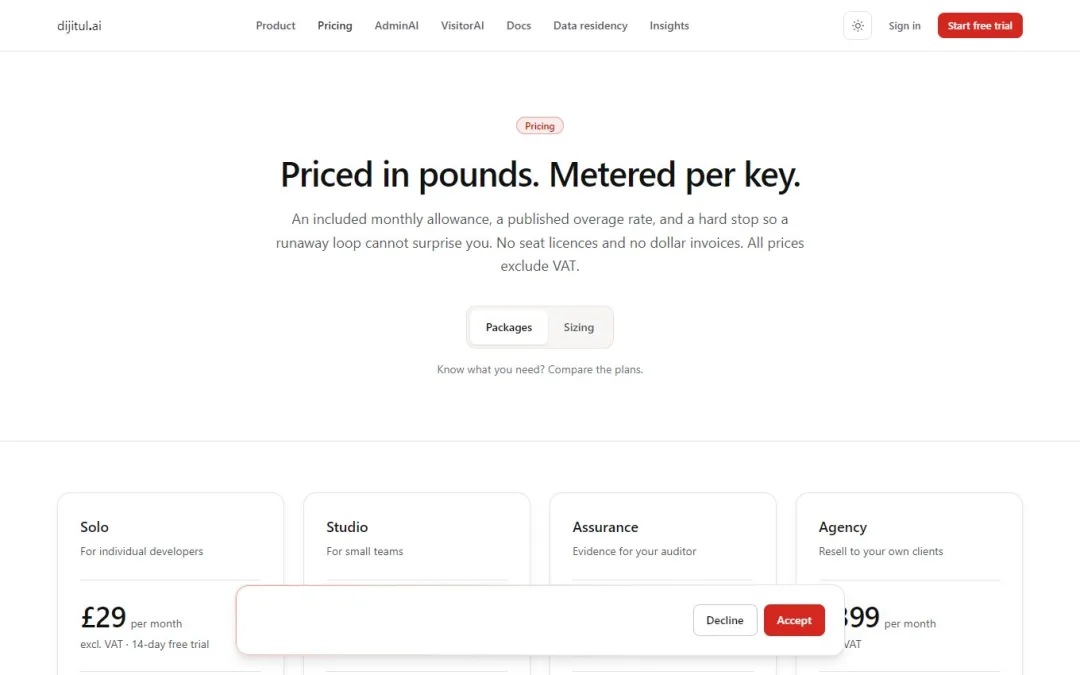
These are the published dijitul.ai plans, all excluding VAT. Check the live pricing page before you budget.
| Plan | Monthly price | Included units | Overage per million units |
|---|---|---|---|
| Solo | £29, after a 14-day free trial | 5 million | £6.50 |
| Studio | £99 | 20 million | £6 |
| Assurance | £249 | 50 million | £6 |
| Agency | £399 | 90 million | £5.50 |
| Regulated | Quoted | Quoted | Quoted |
A unit is one Claude Sonnet input token. An output token counts as 5 units, an Opus token as roughly 1.7, and a cached read as 0.1. There are no seat licences. A hard stop refuses requests once an account runs well past its allowance, so a runaway loop cannot build a huge bill.
A rough worked example, using those weights. An internal tool summarises 200 documents a month on a Sonnet model. Each one is about 3,000 input tokens and 500 output tokens. That is 200 x (3,000 + 2,500), or 1.1 million units, which sits well inside the Solo allowance. This is our arithmetic, not a quote.
If you only need the model and have no UK requirement, the Claude API direct or your own Bedrock account may suit you better. Compare on your own volumes.
WordPress products built on the Claude API: AdminAI and VisitorAI
Two free WordPress plugins run on the same UK route. One key runs both, and neither has a licence fee. They need a dijitul.ai plan because the answers are generated by Claude.
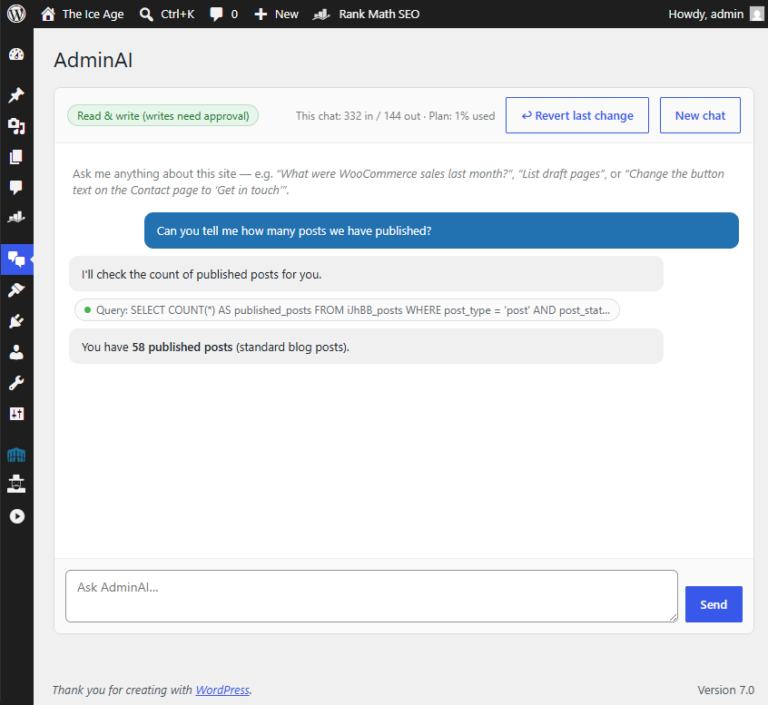
AdminAI sits inside the WordPress admin and can read your site’s database. Ask “which products sold best last month?” and the answer comes from your own data. Every write stops and shows you the exact change for approval, approved changes can be reverted, and a read-only mode switches writes off entirely. We introduced it in AdminAI, a WordPress admin AI assistant.
VisitorAI is the public-facing one: an assistant that answers visitors from your own pages, with links to its sources. The search runs in your own MySQL database, so only the matching passages travel with the question. When it cannot answer, it offers to take the visitor’s details. There are caps per visitor, per conversation and per day.
A caution for agencies. Any plugin that calls the Claude API, or another AI service, from a client’s site adds a supplier to their data flow. The client is normally the controller, you are the processor, and the AI vendor becomes a sub-processor. dijitul.ai’s article on the WordPress AI plugin processor chain has a checklist worth running before you install anything.
Talk to us
Not sure whether your Claude API project needs UK processing at all? Ask us, and we will tell you if it does not. Call 01623 650333, Monday to Friday, 09:00 to 17:30, or send us a message. The UK-hosted route is dijitul.ai, built and run by dijitul, based in Mansfield and working with businesses across the UK. For wider help, see our AI services or the rest of the network.
Frequently asked questions
Where is Claude API data processed by default?
Anthropic’s documentation says the default inference setting is global, which means a request may run in any available geography. Its privacy pages add that traffic may be routed to select countries in the US, Europe, Asia and Australia, and that data is stored in the US. You can restrict inference to the US, at a higher price, but there is no UK-only option when you call Anthropic directly.
Is the Claude API GDPR compliant for UK businesses?
No tool is compliant on its own. You are the controller, so it depends on what you send, your lawful basis, your contract with the supplier and how any transfer outside the UK is covered. Anthropic publishes a Data Processing Addendum as part of its commercial terms. Read it, record your reasoning, and check the ICO’s guidance on international transfers.
Does Anthropic train its models on Claude API data?
Not by default. Anthropic’s privacy pages say inputs and outputs from its commercial products, including the Claude API, are not used to train its models unless you choose to allow it, for example by submitting feedback. The same pages say API inputs and outputs are automatically deleted within 30 days, with some exceptions.
Do I need a transfer risk assessment to use the Claude API?
It depends on the transfer mechanism. The ICO says you must complete a transfer risk assessment when you rely on an Article 46 safeguard, such as the International Data Transfer Addendum. You do not need one when the transfer is covered by adequacy regulations, or when there is no restricted transfer at all. Check which mechanism your contract relies on, and ask the supplier in writing if it is unclear.
Is EU hosting good enough for a Claude API project under UK GDPR?
Usually, yes. The ICO lists every EEA country as having full adequacy, so a transfer from the UK to the EEA needs no extra safeguard and no transfer risk assessment. EU hosting stops being enough when a contract, a client policy or a public sector buyer names the UK. That is a procurement requirement, not a UK GDPR one, but it still binds you.
Is UK data residency the same as data sovereignty?
No. Residency is about where the processing happens. Sovereignty is about who controls the infrastructure. A request processed on AWS in London stays in the UK, but AWS is a US-owned company, which is why dijitul.ai describes its service as UK data residency. If ownership matters to you, look at open models on UK infrastructure you control.
How much does a UK-hosted Claude API cost?
Through dijitul.ai, plans start at £29 a month excluding VAT on Solo, with a 14-day free trial and 5 million units included. Studio is £99, Assurance £249 and Agency £399, with larger allowances. Usage beyond the allowance is charged per million units at a published rate. Check the live pricing page before you budget.
Can I use the Claude API on a WordPress site without sending data abroad?
Yes, through a UK-hosted route. AdminAI and VisitorAI are free WordPress plugins from dijitul that send requests through dijitul.ai, where inference runs on AWS in London. AdminAI answers questions about your site data inside the admin. VisitorAI answers visitors from your published pages. Both need a dijitul.ai plan, and one key runs both.
Written in November 2026. dijitul is a digital agency based in Mansfield, working with businesses across the UK since 2006. All prices exclude VAT. Photos by Yan Krukau and panumas nikhomkhai via Pexels.
Olly Mooney founded dijitul in 2006 and has been building websites since 1996, working on web design, SEO, marketing and hosting for UK businesses from Mansfield. Big car fan.
More about Olly