 Olly Mooney

AI visibility is how often, and how accurately, assistants such as ChatGPT, Gemini, Copilot and Google’s AI answers name your business when a customer asks who to use. You cannot submit for it and you cannot buy a recommendation. You earn it by letting the right crawlers in, stating plain facts on your own site, keeping your details identical everywhere and being mentioned on the pages assistants read. Nobody can guarantee the result.
We covered the problem in August, when we tested our own business: is ChatGPT recommending your competitors instead of you? This is the follow-up: nine ways to improve your AI visibility, in the order we would do them, then how to measure it, what it costs, and when to keep your money in your pocket.

What AI visibility is, and what nobody can promise
A search engine shows ten links and the customer picks one. An assistant gives a short answer that names two or three businesses. AI visibility is whether you are one of them, how you are described, and whether the facts are right.
One thing to be straight about first. Nobody outside OpenAI, Google and Microsoft knows exactly how a recommendation is chosen, and answers change between runs, users and model updates. What those companies do publish is how their crawlers reach your site and what makes a page eligible to be used. Everything below rests on that documentation, plus what we have seen in our own testing, and we say which is which.
The vendors do not promise AI visibility either:
- Google’s guide to AI features in Search says AI Overviews and AI Mode have no extra requirements beyond normal Search eligibility, and that indexing and serving are never guaranteed.
- Microsoft’s Bing Webmaster Guidelines say Bing and Copilot rely on the same crawling and indexing foundation, and put it bluntly: “GEO does not guarantee grounding or citations in AI experiences.”
- OpenAI’s help centre says ads do not influence ChatGPT’s answers, and that claiming a business profile does not guarantee more visibility.
So read “proven” in the title with care. Each of the nine ways is backed by vendor documentation or by our own testing. None is a switch. If the acronyms are new, our explainers on AEO, GEO and SEO and what AEO means cover the vocabulary.
Ways 1 to 3: AI visibility starts with a readable site
1. Let the right crawlers in
If a crawler is blocked, you have no AI visibility with that assistant, whatever else you do. Blocks are often accidental: a robots.txt rule inherited from an old build, a security plugin default, or a firewall setting nobody chose.
These are the names to look for, with what each owner’s documentation says (checked on 20 November 2026):
| Name in robots.txt | Owner | What the owner says it is for |
|---|---|---|
| OAI-SearchBot | OpenAI | Surfacing sites in ChatGPT’s search features. Opt out and you will not be shown in ChatGPT search answers |
| GPTBot | OpenAI | Collecting content that may be used to train models. A separate choice from search |
| Googlebot | Google Search, which includes AI Overviews and AI Mode | |
| Google-Extended | A control for Gemini training and grounding. No effect on Search inclusion or ranking | |
| Bingbot | Microsoft | Bing’s standard crawler. Bing and Copilot share the same crawling and indexing |
| PerplexityBot | Perplexity | Surfacing and linking sites in Perplexity’s results |
| Claude-SearchBot, ClaudeBot | Anthropic | Search indexing, and collecting possible training data |
OpenAI’s crawler documentation makes the point that matters: the settings are independent. You can allow OAI-SearchBot to appear in ChatGPT search and still disallow GPTBot if you do not want your content used for training. For a business that wants customers, we rarely see a good reason to block either.
A two-minute check:
- Open yourdomain.co.uk/robots.txt in a browser.
- Look for “Disallow: /” under any name in the table, or under “User-agent: *”.
- Ask whoever hosts the site whether a firewall, CDN or security plugin blocks AI bots by default.
- Decide each rule on purpose and write down why.
If that is nobody’s job, Search Engine Tuning sets a deliberate policy through its AI crawler configuration service.
2. Put the facts in plain text, answer first
Microsoft’s guidelines tell site owners to put essential information near the top of the page and avoid long introductions. Google’s basics include making important content available as text. Neither says “do this and be recommended”. Both describe pages that are easy to quote correctly.
So open each key page with 40 to 60 words saying who you are, what you do, where, and from what price. An invented plumber, before and after:
- Before: “Welcome to our website. We pride ourselves on quality workmanship and competitive prices.”
- After: “Example Plumbing services and repairs gas boilers in Mansfield, Sutton-in-Ashfield and Kirkby-in-Ashfield. A boiler service costs £85 and takes about an hour. Gas Safe registered, open Monday to Saturday.”
Keep prices as text, not in an image or PDF, and in the page itself, not loaded by a script afterwards. This is the core of AI-ready website design at dijitul web design.
3. Give every service its own page, with real numbers
Microsoft says pages focused on a single topic are more likely to be selected as a source. A page covering six services answers none of them well. So:
- One page per service, with a heading that says what it is and where you do it.
- Prices or from-prices, typical timescales, and the towns you cover, by name.
- A short FAQ in the words customers use, not the words your trade uses.
“Boiler service £85, about an hour” can be quoted. “Competitive prices and a fast turnaround” cannot. That is the biggest practical difference between copy written for AI visibility and old-style sales copy.

Ways 4 to 6: make your business unmistakable
4. Use identical details everywhere
Microsoft’s guidelines ask for clear, consistent naming of organisations and locations. That is the documented part. In our experience, muddled details are an easy way for a small business to damage its own AI visibility: an old address on one directory, a dead phone number on another, three versions of the trading name.
Pick one exact name, address, phone number and one-sentence description. Make them match on your website, Companies House, LinkedIn, Facebook and every directory. If another firm shares your name, lean on what separates you: town, sector, founding year. Search Engine Tuning calls this entity SEO. For a small business it is mostly patient tidying.
5. Add structured data that matches the page
Structured data (schema) describes your business in a format machines read without guessing: Organization or LocalBusiness for who and where you are, Service for what you sell, and sameAs links to your official profiles.
Be realistic. Google says its AI features need no special schema and that markup should match the visible text. Microsoft says structured data may support clearer grounding but guarantees nothing, and that misleading markup may be ignored. For AI visibility, schema removes doubt and nothing more. The schema markup service builds it as one connected description of your business.
6. Complete the profiles the platforms give you
Google lists an up-to-date Business Profile among its basics for AI features. Microsoft says local firms can register with Bing Places for Business so address, hours and contact details stay current for AI answers. Our guide to Google Business Profile in 2026 covers what to fill in.
OpenAI now lets some businesses claim a profile inside ChatGPT. When we checked its help centre on 20 November 2026, local shops and restaurants could only claim an existing US listing, and OpenAI said claiming does not guarantee increased visibility. Worth a look when it reaches you. Not a shortcut to AI visibility.
Ways 7 to 9: earn mentions you do not control
Your own site is only half of your AI visibility. When we ran dijitul through Nusan, the checker we built, the sources the assistants leaned on were local directories, a handful of “best agencies” roundups, and just one of our own guides. That is an observation from our tests, not something a vendor documents.
7. Build a steady flow of genuine reviews
Ask every customer when the job is finished, send a direct link to the review form, and reply to every review, good or bad. Offer nothing in return: Google’s review policy bans incentives such as payment, discounts or free goods.
We cannot tell you how much reviews count towards AI visibility. An assistant can only call you well reviewed if the reviews exist where it can read them, and the same reviews persuade the people who do click through. If you have no system for asking, review management builds one into your normal process.
8. Get listed and mentioned where assistants look
Find the sources first. Ask the assistants your customers’ questions and note which pages they link to. Then get listed, accurately, on the ones that matter:
- Trade bodies and accreditation schemes you already belong to.
- The local and sector directories that keep turning up as sources.
- Local press and “best of” roundups, where you have a real story to offer.
Do not buy links or fake mentions. Microsoft lists link buying as abuse that can cost you visibility. If you hold real news or data, digital PR is the honest route to coverage, though a campaign can fail if the story does not land.
9. Keep it current, and fix wrong facts at the source
Stale facts undermine AI visibility, because assistants repeat what they find. If an old directory says you close at 4pm, some answers will too. Update your pages when prices, hours or services change, and correct third-party listings where the error lives.
Timing varies. Assistants that search the live web can pick up a change within days or weeks. Anything from a model’s training data only moves when a new model is released, which can be months. Correcting the web’s picture of you, source by source, is what generative engine optimisation means in practice.
How to measure AI visibility without fooling yourself
One screenshot of one good answer proves nothing. The next person may get a different one. Measuring AI visibility means asking the same questions, the same way, on a schedule:
- Write 10 to 12 questions a customer would ask, without your name in them: recommendation, comparison, problem and cost questions.
- Ask each assistant, logged out or in a private window, several times.
- Record whether you were named, how you were described, whether the facts were right, and which sources were cited.
- Repeat monthly with the same questions, and judge the trend over three months.
That is free and tedious, which is why we built Nusan, our AI visibility checker. The free check asks one assistant three real customer questions for your trade and town, needs no card and takes about a minute. Paid plans rerun a fixed question set every week and show who is named instead of you.
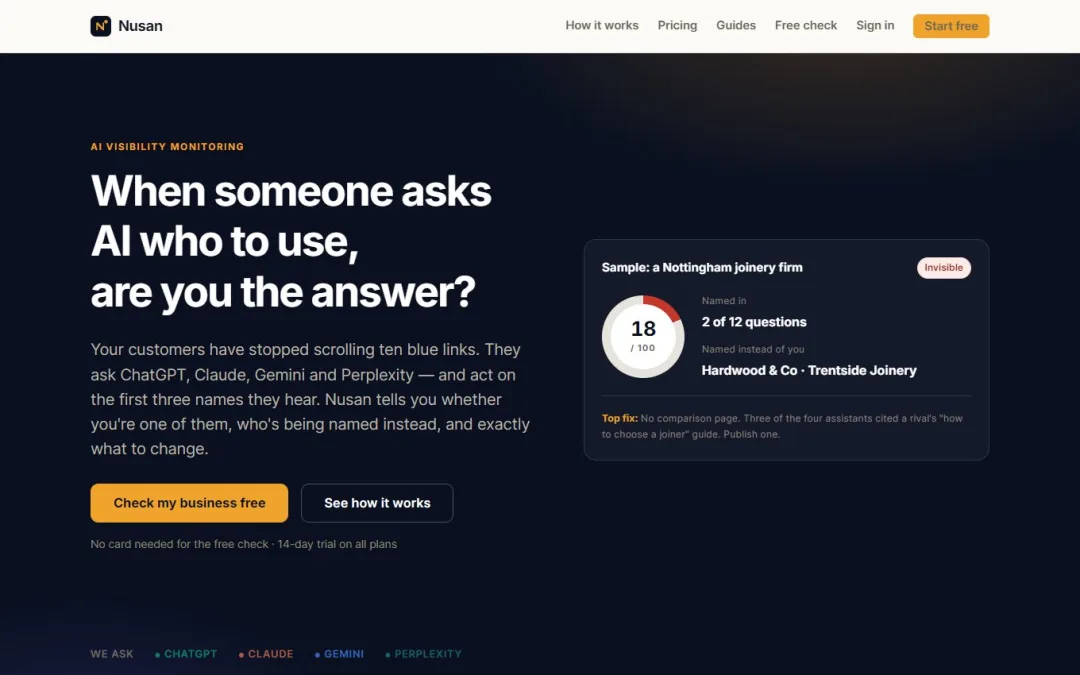
Treat Nusan’s score out of 100 as a direction of travel, not a precise measurement. For Copilot and Google’s AI answers in Search, which Nusan does not cover, use the platforms’ own free data.
| Method | What it covers | The catch |
|---|---|---|
| Nusan | ChatGPT and Gemini on Starter, plus Claude and Perplexity on Growth | Not Copilot or Google’s AI answers |
| Bing Webmaster Tools, AI Performance report | Citations in Copilot and Bing’s AI summaries | Microsoft says the data is a sample and does not show ranking |
| Google Search Console | Clicks from AI Overviews and AI Mode | Counted within ordinary Web search results |
If you want it all read together, monthly AI visibility tracking from Search Engine Tuning runs each prompt several times per assistant and shows the run count behind every figure.
What AI visibility costs
Most of the nine ways cost time, not money. Here is what the paid options cost across our network, all plus VAT.
| Option | Price | What it is |
|---|---|---|
| Do it yourself | Free | The nine ways in your own time, then an hour a month checking |
| Nusan Starter | £29 a month | One business, 12 questions, ChatGPT and Gemini, weekly scan and email |
| Nusan Growth | £89 a month | Three businesses, 30 questions, four assistants, citation tracking |
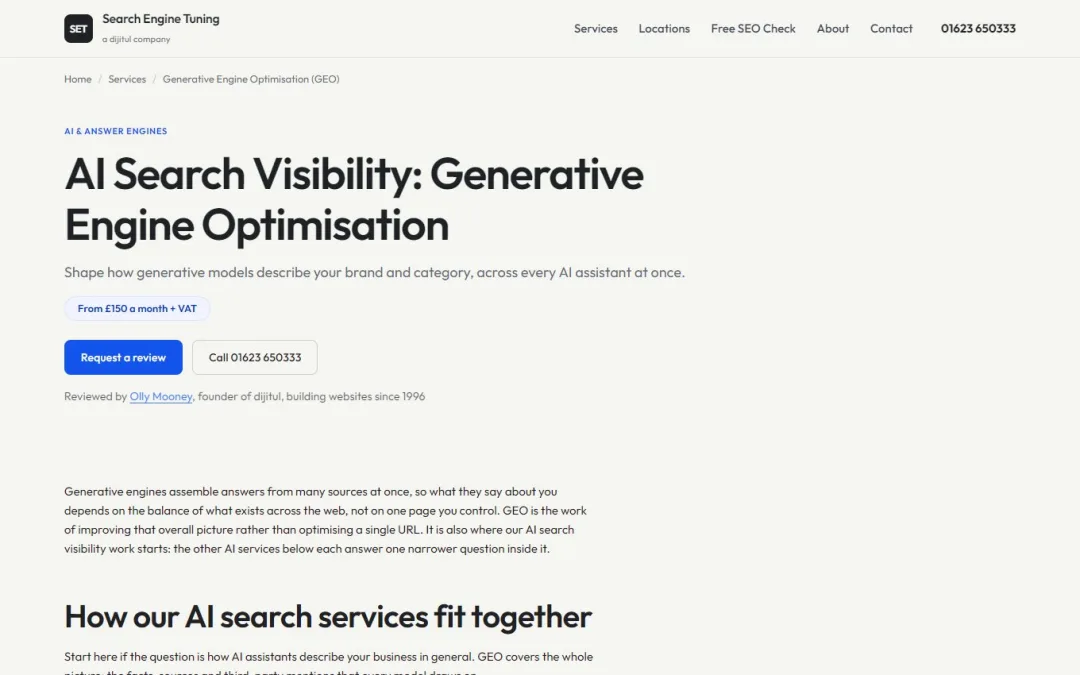
| AI search visibility, Search Engine Tuning | From £150 a month | The source-fixing, content and AI visibility tracking done for you |
| AI-ready website, dijitul web design | Business from £500 | Answer-first pages, schema and a deliberate crawler policy. Smaller Starter sites from £250 |
Nusan plans come with a 14-day trial. Above £150 a month, the Search Engine Tuning price depends on how many sources need correcting and how competitive your category is. An AI search audit measures that before you commit.
Can you just pay to be recommended? No. You can buy ads in ChatGPT, and OpenAI’s Ads Manager listed the UK as available for self-service when we checked on 20 November 2026. But OpenAI says ads run on separate systems and do not influence answers. An ad buys a labelled placement below the answer, not AI visibility. Our sister site handles ChatGPT ads management from £150 a month + VAT if you want to test it.
When AI visibility is not worth paying for
Hold on to your money if:
- Your work comes from referrals and repeat customers, and you are as busy as you want to be.
- You have no proper website or Google Business Profile yet. Fix those first.
- You have not done ways 1 to 6. They cost little or nothing, and an agency would start there anyway.
- The free Nusan check already names you for the questions that matter.
- Someone is offering guaranteed AI visibility in ChatGPT. Nobody can sell that.
For most local businesses, assistants are still a small share of enquiries. We would not move your whole marketing budget into AI visibility in 2026. We would do the cheap groundwork now, because it overlaps with ordinary SEO, and measure before spending more. Our digital marketing overview shows where each kind of work sits.
Common mistakes that hurt AI visibility
- Blocking crawlers by accident, then wondering why ChatGPT has never heard of you.
- Hiding prices, areas and opening hours “so people have to ring”.
- Treating llms.txt as a magic file. It is a community proposal, and Google says you do not need AI text files to appear in its AI features. It is cheap and harmless, so add one after the basics if you like.
- Stuffing pages with keywords or hidden instructions aimed at chatbots. Microsoft lists both as abuse.
- Paying for an “AI visibility score” with no explanation of how it was measured.
Web Design Mansfield has a shorter guide on how to get recommended by ChatGPT.
Talk to us
For a straight answer on your AI visibility, ring 01623 650333, Monday to Friday, 09:00 to 17:30, or send us a message. We are based in Mansfield and work with businesses across the UK. The work is done by Search Engine Tuning, one of the specialist sites in our network, and we will tell you if the free steps are all you need.
Frequently asked questions
How long does it take to improve AI visibility?
It depends on where the assistant gets its answer. Assistants that search the live web can reflect changes to your site or listings within days or weeks. OpenAI says a robots.txt change takes about 24 hours to reach its search systems. Facts that come from a model’s training data only change when a new model is released, which can take months. Judge AI visibility on the trend over three months.
Can I pay ChatGPT to recommend my business?
No. You can buy ads in ChatGPT, but OpenAI says ads run on separate systems, are clearly labelled and do not influence the answers. OpenAI also says claiming a business profile does not guarantee more visibility. A recommendation inside the answer has to be earned through what your site and other sources say about you.
Does blocking GPTBot hurt my AI visibility?
Not for ChatGPT’s search answers. OpenAI documents two separate crawlers: OAI-SearchBot surfaces sites in ChatGPT search, and GPTBot collects content that may be used for training. Blocking OAI-SearchBot is what keeps you out of search answers. Blocking GPTBot may mean future models know less about you. Most businesses that want customers have little reason to block either.
Do I need an llms.txt file for AI visibility?
No. It is a community proposal for a short markdown guide to your site, first published by Jeremy Howard in September 2024. Google says you do not need AI text files to appear in AI Overviews or AI Mode, and no vendor we checked confirms that it changes recommendations. It is quick and low risk, so treat it as an optional extra.
Is AI visibility the same as SEO?
They overlap heavily. Google and Microsoft both say ordinary SEO basics also apply to their AI features. The difference is the target. SEO competes for a place in a list of links. AI visibility is about being named, and described correctly, inside one short answer. In our experience that turns more on specific facts and third-party mentions.
Can anyone guarantee AI visibility in ChatGPT?
No. Google says serving is never guaranteed, Microsoft says optimisation does not guarantee citations, and OpenAI says claiming a profile gives no direct control over ChatGPT’s independent recommendations. Be wary of anyone selling certainty. What you can do is make accurate information about your business plentiful, consistent and easy to read, then measure whether the answers change.
Written in November 2026. dijitul is a digital agency based in Mansfield, working with businesses across the UK since 2006. All prices exclude VAT. Photos by Tim Douglas, Tima Miroshnichenko and Vitaly Gariev via Pexels.
Olly Mooney founded dijitul in 2006 and has been building websites since 1996, working on web design, SEO, marketing and hosting for UK businesses from Mansfield. Big car fan.
More about Olly