Case study · Automotive parts e-commerce
245% more organic orders for Mitzy Bitz
Fixing the technical foundations of a large Mitsubishi parts store, then building category pages that compete for commercial searches — with Google Ads capturing high-intent demand alongside. The traffic grew a little. The orders grew a lot.
- 245% More organic orders 420 to 1,451 tracked order completions
- 6.06% Organic key-event rate Up from 2.53% — a 140% improvement
- 2× Engagement time per user 1m 33s to 3m 16s from organic search
- 588 Google Ads conversions From 109,616 clicks, Jan to Jul 2026
More traffic was never the point
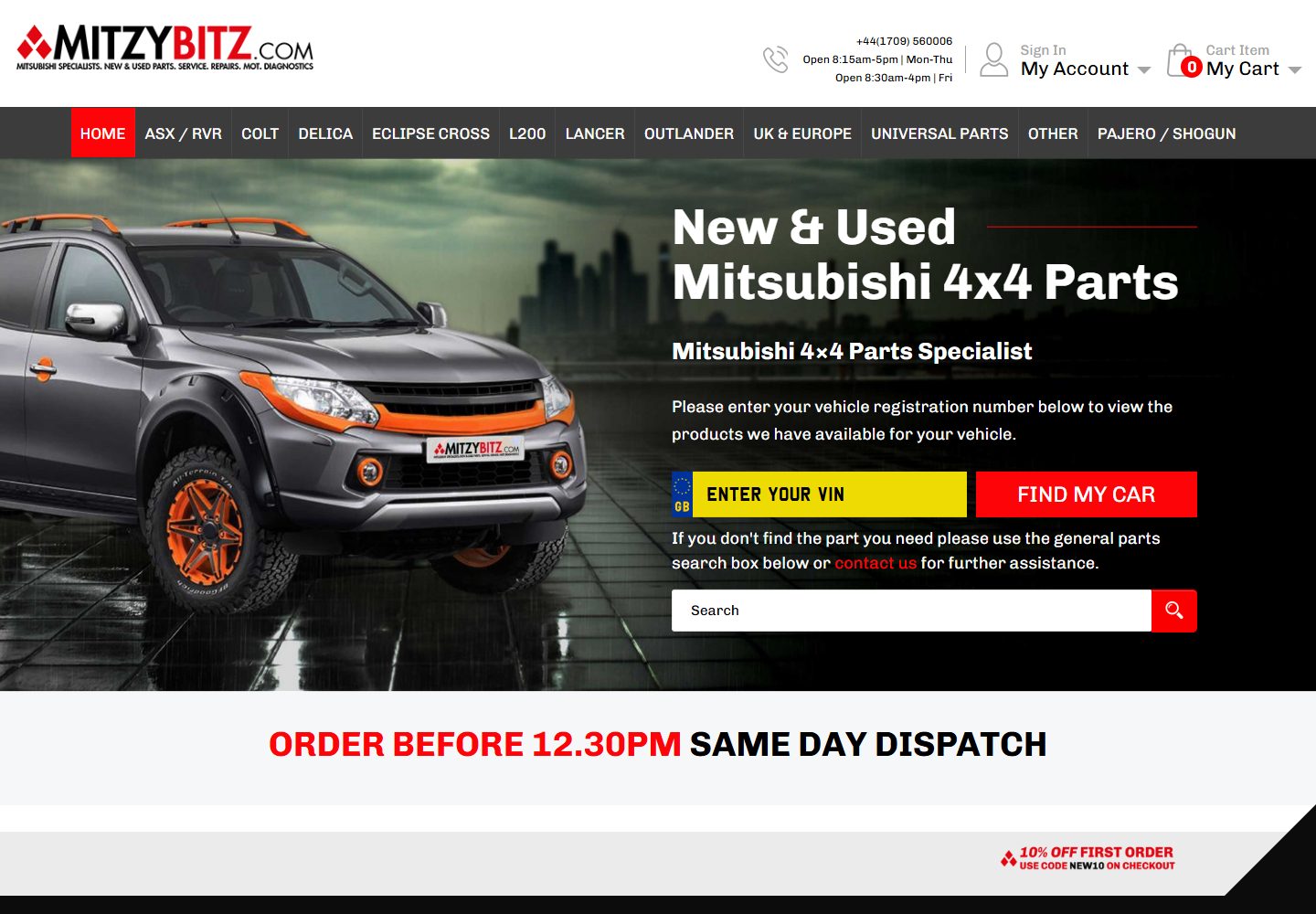
Mitzy Bitz operates a large e-commerce website specialising in Mitsubishi parts — L200, Outlander, Pajero, Shogun and more — with a substantial number of products, categories and vehicle-specific searches to serve. It already had an established online presence and a healthy volume of organic traffic.
What it also had was a set of technical and SEO problems that needed fixing before further organic growth could be unlocked: a very large volume of historical 404 URLs, category pages that were not pulling their weight for commercial searches, indexing and crawl inefficiencies, and important product and category pages that were not being presented to search engines as clearly as they could be.
The objective was deliberately not “more traffic”. It was more relevant users, and more measurable e-commerce actions from them. Alongside the SEO work, Google Ads was used to capture demand across Mitsubishi-related searches through high-intent campaigns.
The website
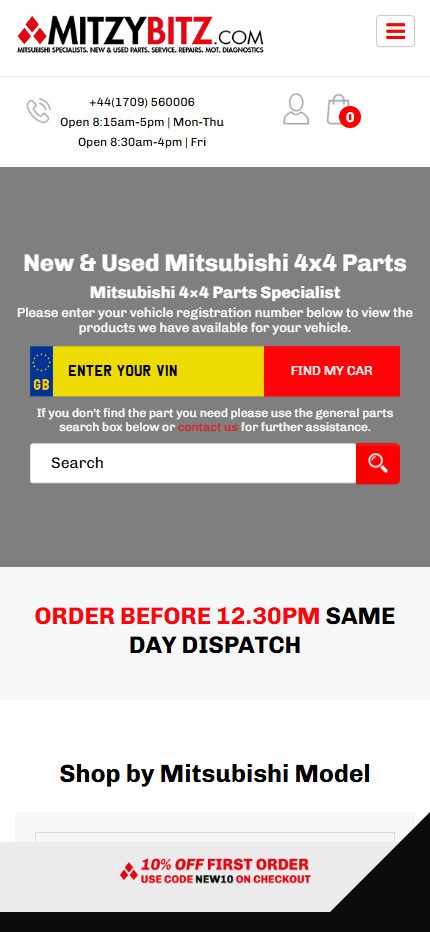
A big catalogue, organised by vehicle
Thousands of parts across every Mitsubishi model — which is exactly why category pages, not individual product pages, had to carry the commercial search demand.
What we did
The work ran in four strands, in roughly this order — because there is little point optimising category pages that search engines are struggling to crawl in the first place.
Strand one
Strengthening the technical foundation
Clearing the problems that were quietly restricting organic performance.
- Dealt with the site’s large volume of historical URLs and 404 issues
- Redirected users and search engines to relevant live pages wherever appropriate
- Improved crawl efficiency so search engines spend their time on pages that matter
- Reviewed the e-commerce structure and identified category pages worth investing in
Strand two
Optimising high-value category pages
Building category pages that compete for broader commercial searches while supporting the product catalogue underneath.
- Improved category page content for key Mitsubishi parts ranges
- Strengthened keyword targeting around commercial search queries
- Developed more useful on-page information for buyers
- Improved internal linking between categories and products
- Aligned each category with its search intent
- Supported important pages with structured data
Strand three
Structured data and search visibility
Clearer signals about what the site contains and how it is organised.
The fourth strand was paid search. SEO was supported by Google Ads to capture high-intent searches while organic visibility continued to develop — Mitsubishi-specific search campaigns, including dedicated activity around the L200, alongside broader sales-focused campaigns. That gives the business a balanced acquisition strategy rather than a dependence on a single channel.
The results
The figures below compare January to July 2026 against January to July 2025, measured in GA4 and Google Ads. Mitzy Bitz was not starting from zero — it already had over 34,000 organic users in the comparison period — so the percentages here are earned against a real baseline.
Before and after
Organic conversions, year on year
January to July 2026 vs January to July 2025. Organic search only.
- Organic order completions 420 → 1,451 +245%
- Organic user key-event rate 2.53% → 6.06% +140%
- Engagement time per organic user 1m 33s → 3m 16s +112%
- Organic users 34,309 → 37,355 +8.9%
Read those four together and the story is obvious. Organic users grew by a modest 8.9%. Organic orders grew by 245%. The gap between the two is the whole point of the engagement: the site is now attracting people who are ready to buy and giving them category pages that make it easy to.
Organic growth
Quality moved faster than volume
Year-on-year change across organic search metrics. Every engagement and conversion measure outgrew raw user numbers by a wide margin.
Returning users are the quiet win
Returning organic users rose by 64%, from 7,093 to 11,645, and average engagement time per user more than doubled. For a parts retailer that is a meaningful signal: people are coming back from search to buy again, and spending long enough on the site to compare fitments and options rather than bouncing to a marketplace. Engaged sessions per user went from 0.83 to 1.18, and organic events — every add-to-basket, every search, every click through a category — more than doubled from 401,092 to 861,176.
Paid search did its job alongside
Google Ads was the second acquisition channel, not a crutch. Across January to July 2026 the account generated 109,616 clicks and 588 conversions — clicks up 65% and conversions up 22% year on year, with the average cost per click falling 23% over the same period.
Google Ads
The campaigns that converted
January to July 2026. Tightly targeted, vehicle-specific campaigns delivered the strongest conversion efficiency.
- L200 search campaign · conversions 301 12.6% conversion rate · £2.22 per conversion
- Sales campaign · conversions 281 14.6% conversion rate · £0.65 per conversion
The L200 campaign alone converted at 12.6%. The broad, catch-all “parts for Mitsubishi 4×4” campaign generated over a million impressions and barely converted — which is exactly the lesson: specific beats broad, and the budget is now weighted accordingly.
Scope
What this engagement covers
Beyond more traffic
Mitzy Bitz entered this period with an established online presence. The work was never about getting found for the first time — it was about strengthening organic visibility on the pages that make money, fixing the technical drag underneath them, and turning more of the existing audience into customers.
The results show clear progress across traffic, engagement and conversion. The strongest commercial indicator is the one that matters most to the business: tracked organic orders up from 420 to 1,451. With PPC providing a second high-intent channel, Mitzy Bitz now has a stronger digital foundation to build on through continued SEO, content, technical optimisation and paid search.
Plenty of traffic, not enough orders?
If your e-commerce site gets visitors but the sales do not follow, the problem is usually in the foundations and the category pages — not the marketing budget. We will take an honest look at where you stand and tell you exactly what is holding it back. No jargon, no lock-in contracts.