

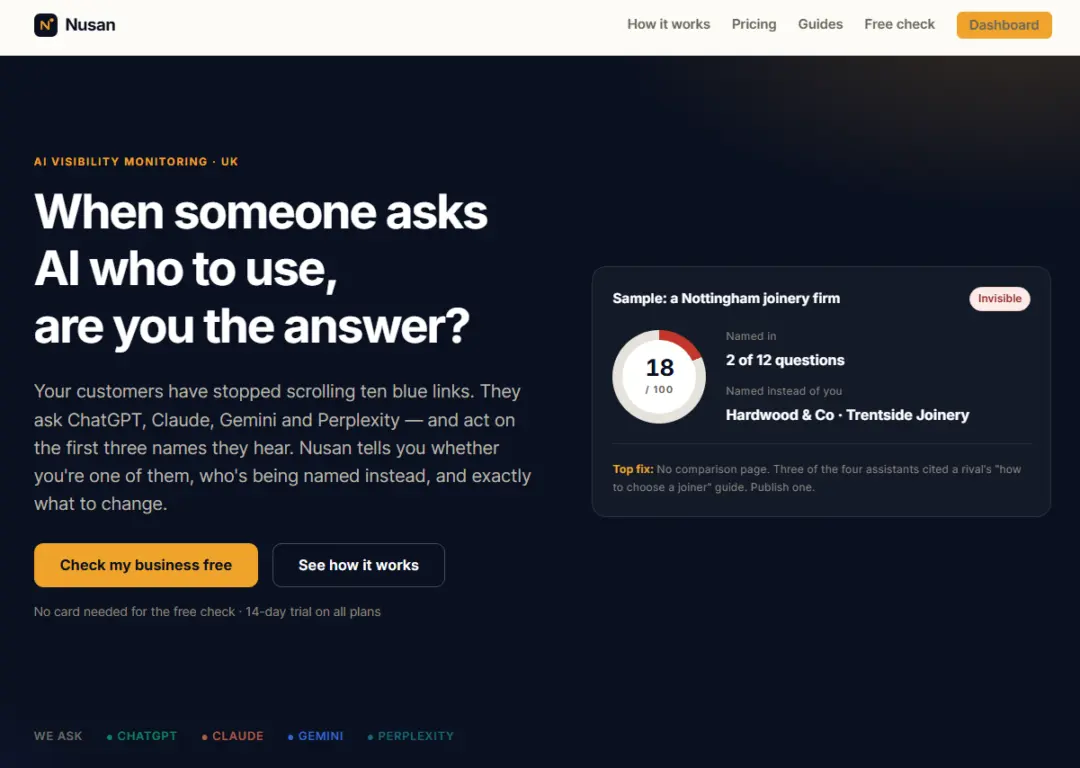
When a customer asks ChatGPT, Claude or Gemini to recommend a plumber, joiner or accountant in their town, the assistant names two or three businesses. If yours is not one of them, you never find out — there is no missed click to see in your analytics, no lost enquiry to count. The recommendation simply went to someone else.
We kept running into this with our own clients, so we built a tool to measure it. It is called Nusan, it is free to try without an account, and this post explains what it does and why we bothered.
What has actually changed about search
Search did not die. It stopped sending you traffic in the same way.
When someone asked Google “best joiner in Mansfield” five years ago, they got ten links and chose one. You could rank fourth and still get the job. When someone asks an assistant the same question today, they get a short paragraph naming two or three firms — and then they ring one. There is no page two. There is no fourth place.
That is a different competition with different rules, and almost nobody is measuring their position in it.
Why your analytics cannot show you this
Analytics measures visits that happened. It cannot show you the recommendation you never received, in a conversation you were never part of.
If an assistant answers a question and the customer acts on it without clicking through, nothing appears anywhere in your reporting. You do not see a drop. You see a slightly quieter month and no explanation for it. That is the blind spot, and it widens every time someone gets into the habit of asking an assistant instead of searching.
What we found when we tested our own business
We ran dijitul through it before we showed anyone. Twelve questions put to ChatGPT, Claude and Gemini — thirty-six answers in total — all the sort of thing a real customer types: “who are the best web design agencies in Mansfield, Nottinghamshire”, “where can I find a web designer near Mansfield who also does SEO”.
We were named in 31% of them. Position 2.1 on average when we did appear. Not terrible. Not remotely good enough either — it means seven times out of ten, someone asking an assistant for a web agency in our own town is handed a competitor’s name instead of ours.
The more useful part was the sources. The assistants were leaning on a specific set of pages to build their answers: local directories, a handful of “best agencies in Mansfield” roundups, and — interestingly — one of our own guides. That tells you exactly where to focus, which is a far better output than a score on its own.
What Nusan actually does
- Writes the questions your customers ask. Real buying questions for your trade and your town. Your business name is deliberately never in the question — the whole point is testing whether an assistant reaches for you unprompted.
- Asks four assistants, weekly. ChatGPT, Claude, Gemini and Perplexity. On a schedule, because a one-off check tells you almost nothing.
- Scores it out of 100. How often you are named, how early in the answer, and how you are described.
- Names who beat you. A league table of the competitors being recommended instead, and how often.
- Shows the sources. Which pages the assistants actually read. This is the actionable bit — it is where being listed and described accurately changes the answer.
- Tells you what to change. Specific fixes based on the questions you missed, not “improve your SEO”.
Why does the answer change every time I ask?
Because these models are probabilistic, personalised by the asker’s own history, and — when they browse — reading a web that changes hourly. Two people in the same town can genuinely get different answers.
We want to be straight about what that means, because it is where a lot of tools in this space start overselling. Nobody can show you a transcript of what ChatGPT said to your customer. Those conversations are private. What can be measured is how the models behave across a consistent set of questions, asked repeatedly — a directional index. It reliably tells you whether you are absent, whether you are improving, and who is being named instead. It is not a transcript, and any tool implying otherwise is misleading you.
Who this is for
Local service businesses with a defined catchment — trades, installers, garages, clinics, salons, agencies. If your customers ever ask “who should I use for this around here”, you have a stake in what the answer is.
It is also built for other agencies. The Agency plan tracks ten client businesses with white-label reports, which works out at £24.90 per client per month. Most agencies resell it around £69 and hold a comfortable margin, and it gives you a genuine reason to call every dormant client on your book.
Try it free, no account needed
The free check asks one assistant three real customer questions for your trade and town, then shows you the answers and whether you were named. It takes about a minute, needs no card and no signup.
If you want the full picture, plans start at £29 a month plus VAT with a 14-day trial and no card required to start.
Frequently asked questions
Can I submit my business to ChatGPT?
No. There is no submission form, no listing process and no paid placement. Assistants draw on their training data and, when browsing, on live web results. The only lever you have is what those sources say about you.
Is this just SEO with a new name?
The inputs overlap — reviews, citations, clear service pages — but the target is different. SEO competes for a position in a list of links a person then chooses from. This competes to be named inside a single answer. We regularly see businesses ranking on page one of Google that are never named by an assistant.
How long does it take to see a change?
Changes to your own site can be picked up within days by assistants that browse the web. Changes that depend on training data move far more slowly, over months. Expect the browsing-based improvement first, and measure on a schedule rather than expecting an overnight jump.
Do I need to be technical to use it?
No. You enter your business name, what you do and your town. Everything after that is automatic, and the recommendations are written for a business owner rather than a developer.
How much does it cost?
The free check needs no account. Paid plans start at £29 per month plus VAT for one business, £89 for three businesses across all four assistants, and £249 for agencies tracking up to ten client businesses with white-label reports. All plans include a 14-day trial and no card is needed to start.
Nusan is built and run by dijitul Ltd in Mansfield. We made it because we needed it ourselves, and we run our own business through it every week.
Leave a Reply